
Vitamine C
Vitamine
Description
L-Ascorbic acid's production and use as in nutrition, color fixing, flavoring and preservative in meats and other foods, as an oxidant in bread dough, in abscission of citrus fruit in harvesting, as a reducing agent in analytical chemistry, and as an antimicrobial and antioxidant in foodstuffs may result in its release to the environment through various waste streams. L-Ascorbic acid is widely distributed in the plant and animal kingdom. If released to air, an estimated vapor pressure of 9.8X10⁻¹¹ mm Hg at 25 °C indicates L-ascorbic acid will exist solely in the particulate phase in the atmosphere. Particulate-phase L-ascorbic acid will be removed from the atmosphere by wet or dry deposition. L-Ascorbic acid contains chromophores that absorb at wavelengths >290 nm and therefore may be susceptible to direct photolysis by sunlight. If released to soil, L-ascorbic acid is expected to have very high mobility based upon an estimated Koc of 10. The pKa of L-ascorbic acid is 4.70, indicating that this compound will exist almost entirely in the anion form in the environment and anions generally do not adsorb more strongly to soils containing organic carbon and clay than their neutral counterparts. Volatilization from moist soil is not expected because the acid exists as an anion and anions do not volatilize. L-Ascorbic acid may not volatilize from dry soil surfaces based upon its vapor pressure. L-Ascorbic acid exhibited moderate biodegradation using an enriched consortia derived from domestic sewage, suggesting that biodegradation is an important environmental fate process. If released into water, L-ascorbic acid is not expected to adsorb to suspended solids and sediment based upon the estimated Koc. A pKa of 4.70 indicates L-ascorbic acid will exist almost entirely in the anion form at pH values of 5 to 9 and therefore volatilization from water surfaces is not expected to be an important fate process. An estimated BCF of 3 suggests the potential for bioconcentration in aquatic organisms is low. Hydrolysis is expected to be an important environmental fate process since this compound contains functional groups that hydrolyze under environmental conditions. L-Ascorbic acid is easily oxidized in aqueous solution in the presence of air. Occupational exposure to L-ascorbic acid may occur through inhalation and dermal contact with this compound at workplaces where L-ascorbic acid is produced or used. Use data indicate that the general population is exposed to L-ascorbic acid via ingestion of food, medicines, and other consumer products containing L-ascorbic acid. (SRC)
Mecanisme
L'acide L-ascorbique agit comme un cofacteur essentiel dans diverses réactions enzymatiques, notamment la synthèse du collagène et le métabolisme des neurotransmetteurs.
Medicaments contenant Vitamine C
- B MN BIOTIME Poudre orale apportant vitamines et oligo-éléments pour animaux de rente
- PYREVALGINE Poudre antipyrétique et antalgique pour équins, veaux, agneaux, chevreaux, volailles et chiens
-
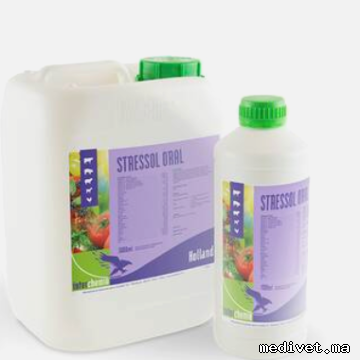 Stressol Oral
Solution de vitamines, acides aminés et minéraux pour le bétail et la volaille.
Stressol Oral
Solution de vitamines, acides aminés et minéraux pour le bétail et la volaille.
-
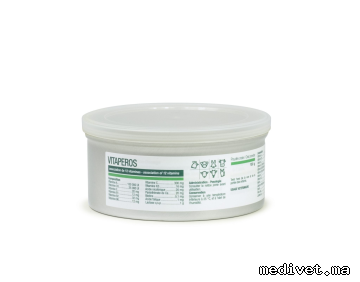 VITAPEROS
Complexe vitaminique pour la prévention des états carentiels chez les jeunes ruminants et équins ainsi que chez les volailles et lapins
VITAPEROS
Complexe vitaminique pour la prévention des états carentiels chez les jeunes ruminants et équins ainsi que chez les volailles et lapins